
Our Production Process
From billet and hot-rolled coil to silicon steel, cold rolled, galvanized and wire rod products — a step-by-step look at how we control thickness, surface, coating and magnetic properties at every stage of manufacturing.
From Raw Material To Finished Coil
Five Production Routes
Click any route below to expand its full sequence of equipment steps and quality control points.
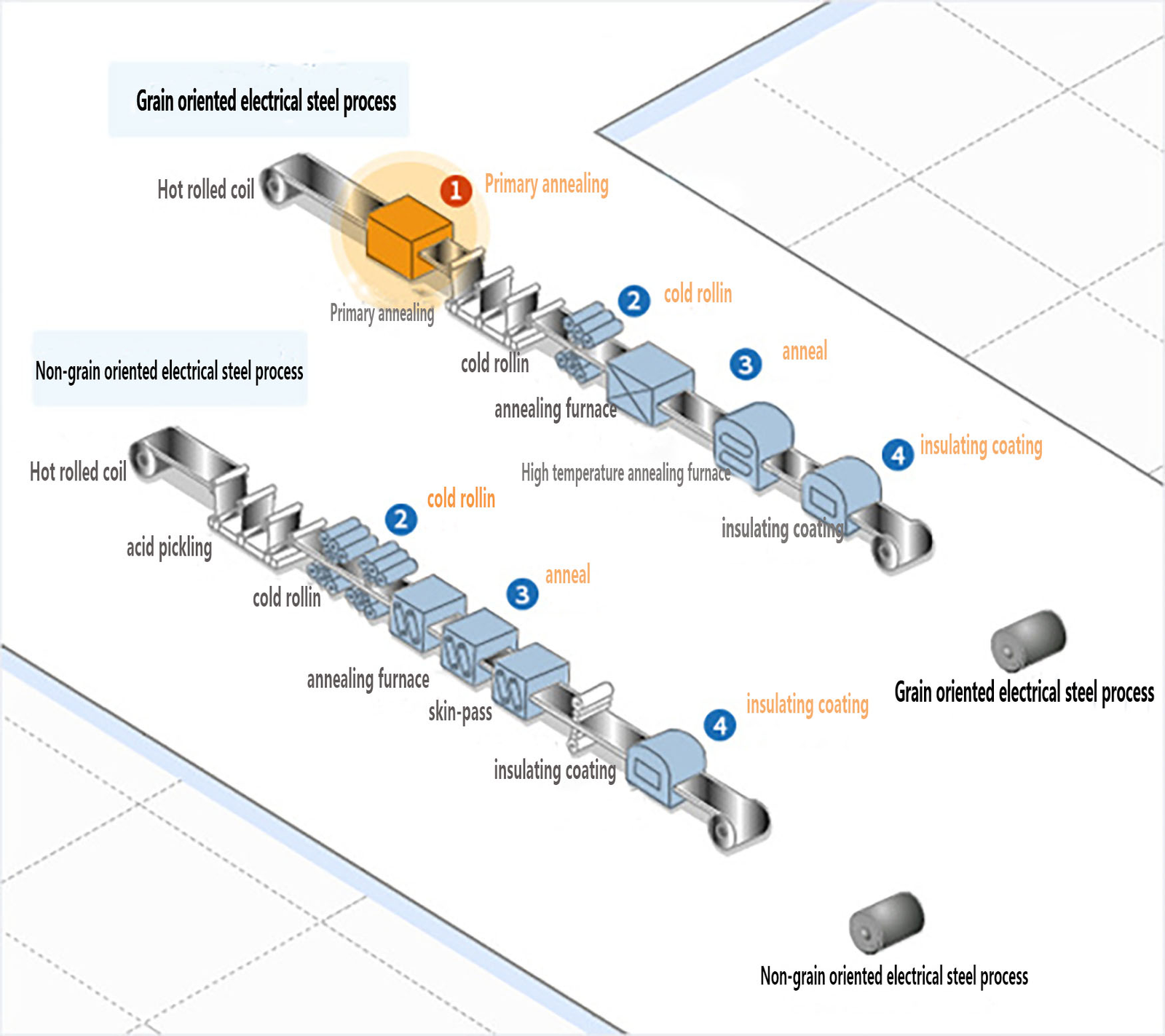
01Silicon Steel (Electrical Steel) Process4 steps
Heat treatment and insulation coating are the key stages that define the final magnetic properties of grain-oriented and non-oriented electrical steel.
Preliminary Annealing
In the preliminary annealing process, the scale that may form on the hot-rolled steel is removed after delayed passage through the water breaker and hydrochloric acid bath. This initial heat treatment improves the cold rolling properties and magnetic properties of the steel.
Cold Rolling
In order to obtain specific thickness and material properties, a reduction ratio of 40–90% is usually used. Automatic control of the edging mill ensures uniform thickness and width.
Annealing
Annealing transforms cold-rolled tissue into recrystallized tissue through heat treatment. For grain-oriented electrical steel there are two methods: decarburization annealing, which removes excess carbon and applies a magnesium oxide coating, and high temperature annealing, which produces a secondary recrystallization structure with superior magnetic properties.
Insulation Coating
The insulation coating is applied by a continuous coater roller to minimize eddy current losses proportional to sheet thickness. Grain-oriented steel has two layers: a dark brown Forsterite (Mg2SiO4) base coating and a transparent phosphate insulating coating. Non-oriented steel uses various coating methods with different thicknesses and compositions according to end use.
02Hot Rolled Steel Process4 steps
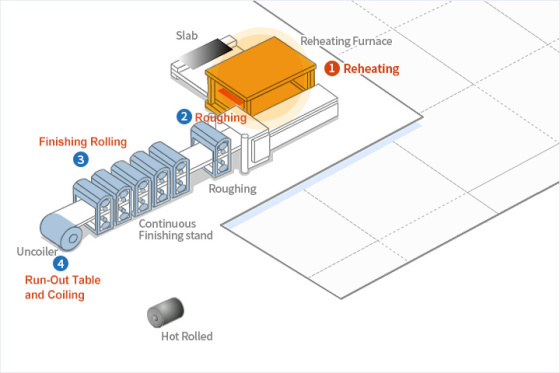
Slab reheating, roughing and finishing rolling shape the coil to the specified dimensions, with crown and surface quality controlled by modern mill equipment.
Reheating
Hot rolled coils pass through a pickling line, where scale breaker machines and hydrochloric acid solutions are used to remove any surface scale and/or oxide film that cause surface flaws during the final stage of cold rolled steel processing.
Roughing
Slabs whose surface scale has been removed are made into rolled materials with the proper shape, thickness and width. In the entry and exit area of the roughing mill, an edger rolls the strip in the width direction using an Automatic Width Control (AWC) system.
Finishing Rolling
Finishing rolling adjusts the thickness and width of a coil to the specified dimensions and produces a smooth surface and shape at the desired finishing temperature. Work Roll Shift Mills, Pair Cross Mills and On-line Roll Grinders (ORG) enhance productivity and improve finished coil quality by controlling the crown shape.
Run-Out Table and Coiling
Steel strips, after the finishing mill, are passed to the run-out table where they are coiled. While being rolled on the table, the strips are sprayed with water to cool them to the proper temperature for coiling.
03Cold Rolled Steel Process5 steps
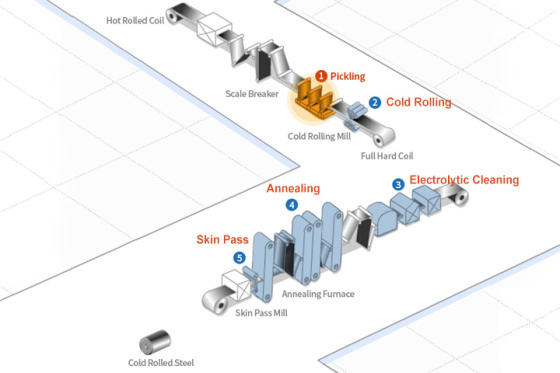
Pickling, tandem cold rolling, electrolytic cleaning, annealing and skin pass deliver the extra deep drawing qualities and surface finish required by downstream customers.
Pickling
Hot rolled coils pass through a pickling line, where scale breaker machines and hydrochloric acid solutions are used to remove any surface scale and/or oxide film that cause surface flaws during the final stage of cold rolled steel processing.
Cold Rolling
Pickled coils are cold rolled in tandem mills to a specified thickness, typically 40 to 90% of original material dimensions. Fully automated shape adjustment is ensured through state of the art process machinery.
Electrolytic Cleaning
The purpose of electrolytic cleaning is to remove lubricant oil and contaminants on the cold rolled steel prior to the annealing process.
Annealing
A highly productive manufacturing method whereby steel products with extra deep drawing qualities and high tensile strength can be produced. Two annealing methods are commonly used: batch annealing and continuous annealing.
Skin Pass
This final rolling process removes minor surface defects such as stretch marks and produces a smooth, lustrous surface. Skin Pass results in a further thickness reduction of about 1%.
04Galvanized Steel Process6 steps
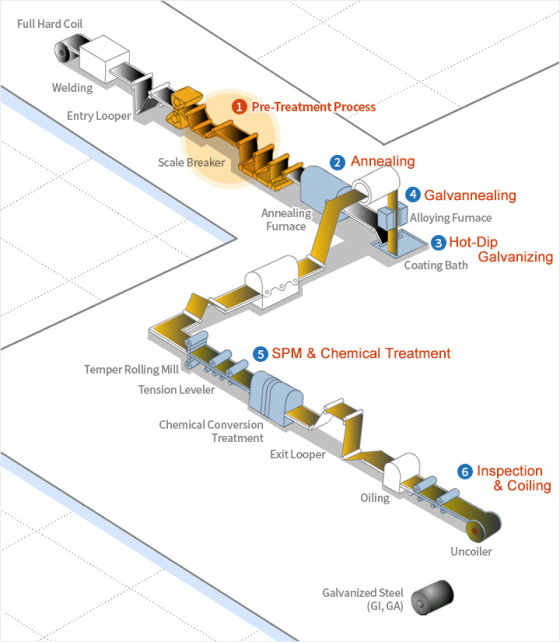
Continuous pre-treatment, recrystallization annealing, hot-dip zinc coating, galvannealing and chemical treatment build long-lasting corrosion resistance into every coil.
Pre-Treatment Process
Some rolling oil and other contaminants remain on the surface of cold rolled steel sheets following processing. These are removed by passing the electrically charged sheet through an alkaline solution which induces an electrochemical reaction.
Annealing
The material properties of the pre-treated steel sheet can be altered and improved through recrystallization during the annealing process.
Hot-Dip Galvanizing
After passing through the annealing furnace, steel sheets are dipped into a zinc pot where molten Zn is coated onto the surface. The desired coating weight is achieved by removing excess zinc before solidification with high-pressure air from an air knife.
Galvannealing
The surface of a steel sheet, after the air knife, can be coated with a zinc compound prior to reheating in an annealing process. Zn atoms diffuse into the Fe to create a Zn-Fe series alloy.
SPM & Chemical Treatment
To achieve a flat surface and an elegant finish, the steel sheet is processed with a skin pass mill. To prevent the white rust which often forms on the surface of activated zinc and to improve corrosion resistance, the surface is coated with a Cr-free resin.
Inspection & Coiling
In order to achieve a flat surface and an elegant finish, the steel sheet is processed with a skin pass mill. In order to prevent the white rust, which often forms on the surface of activated zinc, and to improve corrosion resistance, the surface is coated with a Cr-free resin.
05Wire Rod Process5 steps
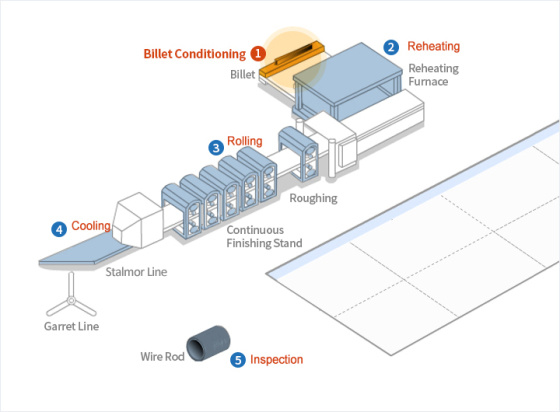
Billet conditioning, controlled reheating, rolling and cooling are tuned to the carbon grade so the rod meets the drawing and softness requirements of each application.
Billet Conditioning
This process is intended for checking the surface quality of billet and removing any defects. Shot blast is used to remove any scale from the surface. Magnetic particle testing and visual inspection identify defects which must be removed using a grinder. Ultrasonic testing and dimension and geometry checking are also applied as part of the internal quality assurance process.
Reheating
The temperature within the furnace and the duration of reheating depend on where the product will be used. To avoid decarburization, which can affect surface quality, a billet is pre-heated sufficiently at a low temperature before being rolled within the reheating furnace. For this purpose, the fuel and air ratio are strictly controlled.
Rolling
The temperature, draft and speed of deformation with which the product is rolled are controlled to meet customer requirements for material features. Further measures to ensure surface quality include adjustment of roll roughness and gap, detection of any cracks and dimension correction.
Cooling
Coiling temperature at the laying head, the air flow and movement speed of the blower on the cooling bed and the cooling speed of the insulation cover are controlled. High carbon steel wire rods are subject to fast cooling to achieve the microstructure required for successful drawing, while low carbon steel is subject to slow cooling to ensure the softness required to eliminate an annealing process.
Inspection
Samples are taken from the front and rear edges of the product after rolling and cooling for testing to identify any defects in the dimension or surface or material integrity. Packaging and tagging are also inspected according to customer requirements prior to shipping.
Process Diagrams
Six product process diagrams. Click any image to open the full-size version.
Need A Specific Grade Or Specification?
Send us your required standard, thickness, width and coating weight — our team will confirm the production route and quote within 24 hours.